Plan a family trip around the people actually taking it
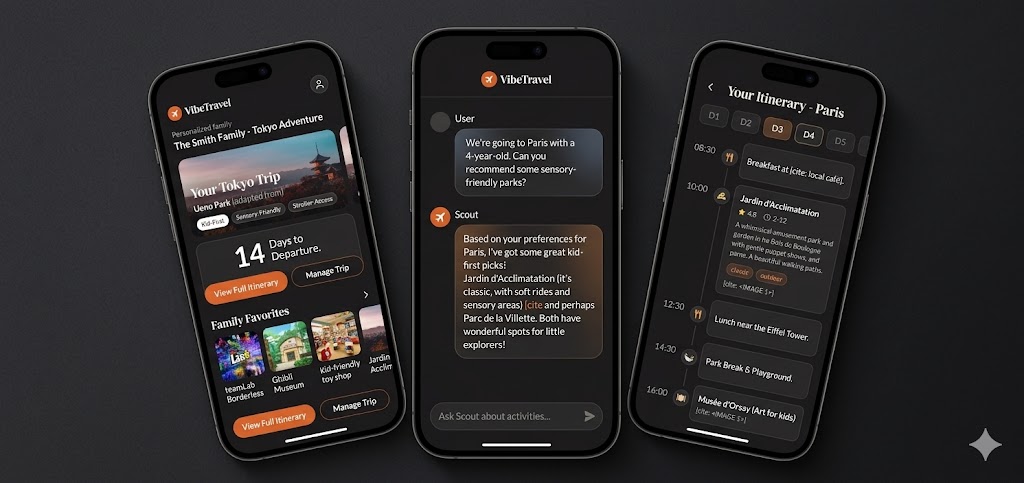
I built an AI travel planner that learns a family’s pace, ages, sensory needs, diet, and budget—then turns that context into grounded recommendations and realistic itineraries.
cities available worldwide
external APIs integrated
personalized options per destination
reused across the whole journey
Generic travel advice breaks down when a family arrives
Parents can spend hours combing through “top 10” lists that ignore naps, energy levels, sensory needs, dietary restrictions, and the simple logistics of moving with young children.
The product opportunity was to treat those constraints as the foundation of the plan—not as filters added after a generic itinerary had already been generated.
Set the context once. Use it everywhere.
Vibe Travel begins with a durable family profile and makes it the personalization engine for search, attraction recommendations, and day-by-day planning.
The inputs that change a trip
“Personalization only works when the context is right.”
Core product principle
Connect discovery, planning, and adaptation
The experience follows the way families actually make decisions: broad inspiration first, confidence-building detail next, then a plan that can flex when real life intervenes.
Discover
Search a destination through the family’s interests and constraints.
Compare
Review ratings, hours, accessibility, weather, and fit.
Plan
Build realistic days around meals, energy, and nap windows.
Adapt
Refresh the itinerary conversationally as needs change.
Let a family plan through conversation
Scout is a tool-enabled AI assistant that can search destinations, save attractions, answer follow-up questions, and assemble an end-to-end itinerary from one prompt.
Trips rarely begin as a form
Parents naturally describe tradeoffs: “We want one big activity, a slow afternoon, and somewhere our picky eater will be okay.” Scout preserves that nuance while grounding the response in live product data.
Search · Save · Build itinerary
Reduce hallucination by enriching the model with live context
I integrated external sources so the AI could reason with useful facts instead of relying on generic travel knowledge alone.
Ratings, opening hours, addresses, and place details.
Conditions that can reshape a family’s day.
Bookable tours and destination activities.
Destination context and attraction background.
Conversational reasoning and tool orchestration.
The product’s own source of personalization truth.
Build the product around the full planning loop
Personalized destination results enriched with real place data.
Day plans that reflect energy, meals, pace, and recovery.
Accessibility and sensory notes remain visible during evaluation.
Authentication, database, and trip management built on Supabase.
A working product, free to explore
AI becomes useful when the product gives it durable context
The differentiator was not the ability to generate an itinerary. It was the system around the model: a reusable family profile, grounded destination data, tool-enabled actions, and a planning experience that respects how families actually move through a day.