
Are you building what your customers want, or are you just building?
Its difficult to “study” product management via the consumption of online trainings, content, and literature and not come across Melissa Perri’s work. Its equally difficult to not perpetually think about the intended impact of a product or feature as you’re in the middle of a sprint working to ship it (Can’t just be me). In a world where many product organizations champion “shipping features” (and not so much delivering), as a default measure of success, its quite easy to unintentionally get caught in the cycle of building and releasing without clear direction or strategy.
These thoughts made it easy for me to pick up Melissa Perri’s 2018 “Escaping the Build Trap” for guidance. I’d solidly recommend this read for builders and product folk alike in order to truly accelerate innovation, drive user value, and growth. Here’s why:
What is the Build Trap? (Outcomes > Outputs)
Put simply, the build trap is when organizations rely on measuring success in terms of outputs rather than outcomes. While it is ok to measure and track the execution and launch of features, organizations must not get lost in measuring the value those features/outputs actually provide for end users. This is the overarching theme of the book. Anticlimactic maybe, but this seemingly is a fleeting approach to “doing” product, thus the need for this mindset correction. Perri advocates for a shift towards outcome-driven strategies, emphasizing the importance of understanding customer needs and delivering solutions that genuinely address them.
This has certainly shifted my mental model a bit by now being able to divorce value from the product. Here me out: There isn’t really inherent value in the product itself. Products deliver value only when they solve real user problems or satisfy their desires. Adding new features doesn’t increase the value. And no customer value means no business value.
Ok, cool. How should I determine my desired outcomes?
This likely should have been determined prior to the product team ever being assembled, as the concept of strategic product management, urges organizations to establish a clear product strategy that aligns with business objectives. This involves setting measurable goals, defining key performance indicators, and regularly assessing progress. In other words, strategy should be leveraged as a “connector” of sorts. Strategy should connect vision to economic outcomes. It should connect products to initiatives, so on and so forth (Read my piece on product visionining). Perri asserts good strategic product management is “not a plan but a framework that helps to make decisions!”. Strategy is created and deployed at each level and across the company.
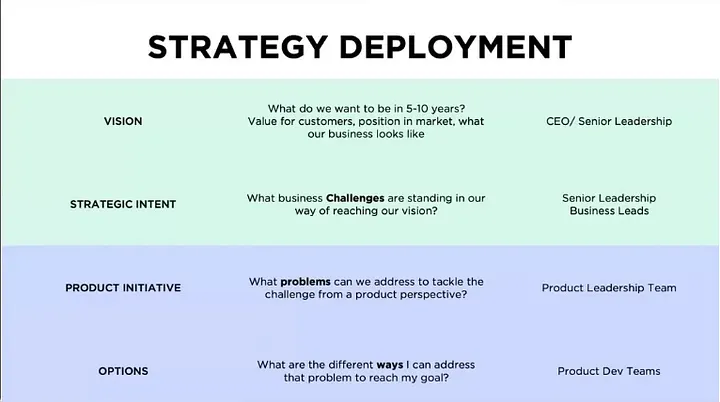
She references “The Art of Action”, by Stephen Bungay, who defines strategy as: “a deployable decision-making framework, enabling action to achieve desired outcomes, constrained by current capabilities, coherently aligned to the existing context.”
Perri gives a pretty insightful anecdote about Netflix-Roku, to drive this point home. In short, Netflix (2007) was supposed to enter the hardware market by launching Roku. However, due to their strategic framework in place (focusing on delivering quality content), it enabled Netflix to make a shift to enable Netflix on the Xbox instead of launching the Roku. Netflix focused on a solid vision and organized its key initiatives around outcomes. Read more on project Griffin HERE.
Continuous Learning, Problem Discovery, through a customer centric lens.
Perri underscores the importance of placing the customer at the core of product development. By aligning organizational goals with customer needs, organizations can create products that resonate with their target audience, fostering long-term success. Again, a core principle of product work, that can easily get lost in agile environments. Product teams should operate within a culture of continuous learning. Product leaders specifically should understand how their teams have incorporated experimentation and customer feedback as an input into product improvement.
The practice of delivering against customer needs is most notably highlighted in Perri’s Product Kata. The Product Kata is the process by which we uncover the right solutions to build. It’s a systematic way that teaches product managers to approach building products from a problem-solving standpoint. The Product Kata helps product people form incredibly impactful habits. Doing it over and over again, exactly like a martial arts kata, ingrains the process in your brain. It’s an adapted version of the Toyota KATA, a PDCA cycle tailored to Product Management.
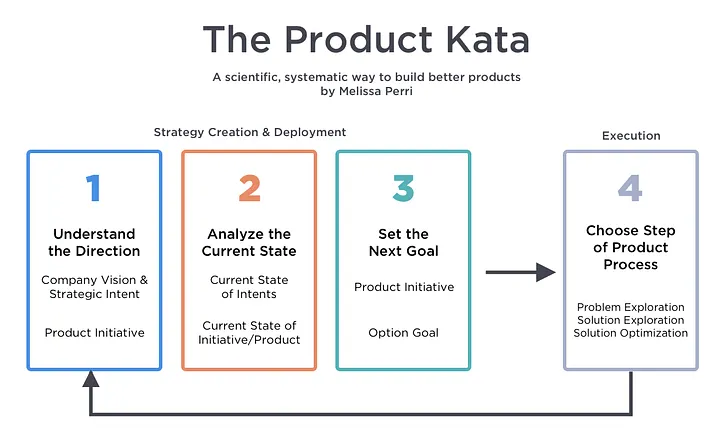
If you’re anything like me, incrementalism is a confidence booster, but also emits directional signals that let you know smaller features and enhancements are moving in the right direction, based on customer interaction. This only can come from being in tune with the pulse of the end customer. There is no best way to conduct user research, and product folks should not rely on a single source for feedback. Through constant and various user interaction mediums, you’ll get access to anecdotal data in which can be validated through experimentation. Perri encourages teams to set up a good discovery/delivery cadence.
Becoming Product Led
Ok, Buzzterm time…In the final last chapter of the book, Perri talks about how to achieve becoming truly “product-led” or Product Led Growth(PLG). This the culmination of many of the concepts she introduces throughout the book. When orgs adopt a culture that organizes around outcomes, they’ve achieved PLG. Product-led companies understand that the success of their products is the primary driver of growth and value for their company (as opposed to being led by sales, visionaries, or technology). They prioritize, organize, and strategize around product success. This is what gets them out of the build trap. Here’s Oji Udezue really driving the point home for organizations seeking PLG status.
Escaping the Build Trap is a must-read for anyone involved in product management, from seasoned professionals to those just starting their journey. Perri’s insights provide a comprehensive and actionable guide for organizations to break free from the build-centric mindset and pave the way towards strategic, customer-focused product development. By implementing the principles outlined in the book, companies can foster innovation, create sustainable growth, and truly thrive in today’s competitive landscape.
