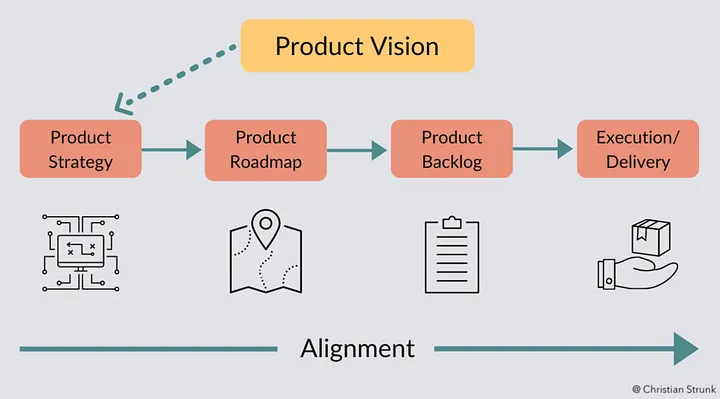
As a (relatively) new Product Manager, becoming bombarded with product specific frameworks and jargon is highly likely. Product Roadmaps, strategies, use cases, OKRs, BRDs, the list goes on when it comes to toolsets and frameworks that might prove to benefit those serving in a product owner/manager capacity. One concept though, that I feel there isn’t nearly enough writing and guidance on, is the ability to develop a clear product vision. The goal of a product vision is to provide a clear (yet, compelling) picture of the future state of the product, including its purpose, value proposition, and long-term goals, that guides the team’s efforts and decision-making…In essence, it should inform all of the downstream frameworks mentioned above (shown in the image from Christian Strunk below). I’ll spend the next few paragraphs describing my experience and share insights while executing the iterative process of developing a product vision document.
What is a product vision?
For clarity, references to product vision in this post refer to a long term product vision capturing in some sort of strategy document, going beyond the more concise “product statement”, which has its own value. Long term product visioning tends to range from three to five years, with shorter cycles within this period.
In a nutshell, a product vision tells the story and paints the picture of an ideal product experience which solves for user problems and creates business value. Why does your product exist? How will you achieve your why? What is your product? As mentioned earlier, your vision to should help readers/leaders envision how your product will live among targeted users (this varies based on product scope i.e., B2B, B2C, etc.), its future state which should include purpose, value proposition, and long-term goals. Your product vision is your NORTH STAR.

In typical product management fashion, your vision document requires buy-in. In the end, you want core stakeholders to understand the why behind the vision for your product. I’ll take it a step further by noting, the product vision document should not only serve as a communication tool that helps in aligning the entire team, stakeholders, and investors around a shared understanding of the product’s direction, but in its development collaboration should be present. Core stakeholders should be privied to early versions of the documents, and there feedback and input should be sought out in the document’s development. This increases the likelihood of buy in, and also may strengthen the document as stakeholders might add blind spots or considerations beyond what product teams are able to see. A great way to create a shared product vision is to employ a collaborative visioning workshop. (I’d argue this could be done on existing products).
Customer/User definition
User definition is one of the sneakiest, should be simple questions that product owners have to deal with. This should go with out saying, but your product vision document should clearly define your target customers/users and the market segment you aim to capture. It should detail an understanding of their needs, desires, and current pain points. This inherently highlights the market opportunities that exist, opening the door to showcase value proposition that your product brings. There are interesting ways to use storytelling to help sell customer value prior to product development. Mandy Cornwell does a great job summarizing this approach HERE.
Aspirational vs. Practical
Your product vision should think big, and aim to be aspirational. This is where experienced product individuals, or developers/engineers may struggle (Key word: MAY). The inevitable “HOW” part of the product development lifecycle may cloud the ability to think freely (without considering limitations) when it comes to ideating around the larger impact you want your product to have on customers and society. The product vision should be intentionally broad and ambitious so that it engages the audience while pushing the limits on imagination. Product teams should resist the urge to “think practically”, and “realistically” in order to not stifle an aspirational vision for the product. After all, this will happen as development teams begin to triage the “HOW” and determine level of effort (LOE) estimations.
Refer to the vision early and often
(Queue another NORTH STAR reference) — Use your product vision to guide decisions, measure impact, prioritize features, frame marketing, etc. throughout the product lifecycle. The vision document should be a document you can “whip out” for new stakeholders and those who want a detailed understanding of the reason for creating the product. While the vision alone is certainly not enough, it is a first filter for new ideas and change requests. As Roman Pichler simply frames.. “Anything that helps you move closer to your vision — be it a new feature, a change of direction, or a new technology — is helpful and should be considered; anything that doesn’t, is not beneficial and should probably be discarded.”
Writing a compelling product vision document requires a combination of strategic thinking, creative storytelling, and effective communication. It serves as the foundation upon which your product is built, providing clarity, direction, and inspiration to your team. Invest time and effort in crafting a vision document that captures the essence of your product, resonates with stakeholders. Bhushan Shinkre, has a brilliant talk on product visioning and strategy below. Cheers!
